


The history of tailings dam failures, marked by large-scale events such as the breaches of Mount Polley (2014, Canada), Fundão (2015, Mariana – Brazil), and Brumadinho (2019, Brazil), has highlighted systemic failures in governance, risk management, and the adoption of good engineering practices. These disasters resulted in irreparable human losses, widespread environmental damage, and lasting socio-economic impacts, reinforcing the urgent need for a new global safety standard for tailings facilities.
In this context, the GISTM was developed and launched in 2020 through a joint initiative by the ICMM (International Council on Mining and Metals), UNEP (United Nations Environment Programme), and PRI (Principles for Responsible Investment). The GISTM’s primary goal is to prevent harm to people and the environment, requiring operators to prioritize the safety of tailings facilities throughout all phases of their life cycle. To that end, the standard provides a comprehensive framework for the safe management of tailings facilities.
The GISTM is structured into six topics, comprising 15 principles and 77 auditable requirements. These topics cover a range of issues, from engagement and respect for affected communities to the development of an integrated base of technical and social knowledge, to robust design, construction, operation, and continuous monitoring. Additionally, the standard outlines best practices for corporate governance and management, emergency preparedness, and long-term recovery, and emphasizes public disclosure and access to information, ensuring transparency and accountability at every stage of the tailings facility life cycle.
It is important to note that compliance with the GISTM does not replace adherence to statutory, legal, regulatory, or local requirements. Operators must ensure that the standard’s requirements are met as long as they do not conflict with applicable laws.
In the Brazilian context, according to the “Panorama GISTM Brasil” published by KPMG, there are currently 269 dams classified as having high associated potential damage, managed by 73 mining companies. Of these, only 16 companies (22%) have committed to GISTM, covering 108 critical structures (40%). Compared to the 2022 edition, a modest yet relevant 4% increase in adherence has been observed. The report also highlights improved transparency, with 32% of mining companies disclosing emergency response plans in 2024, compared to 22% in 2022. Despite this progress, the study shows that most critical dams are concentrated under a small number of operators, indicating that advances are primarily among larger companies, while a large part of the sector still does not follow international safety guidelines.
Thus, while the GISTM represents a landmark for safety and sustainability in tailings management, its full implementation, both in Brazil and globally, is still underway. Many companies remain in the early stages of adaptation, facing operational, technical, and governance challenges in achieving full compliance with the standard’s auditable requirements. In this context, conducting and sharing case studies becomes an essential tool. These studies support the exchange of best practices and lessons learned, offering practical insights into how companies are overcoming challenges and implementing the GISTM across diverse geographic and operational realities.
Accordingly, this study aimed to assess the compliance of a tailings facility with the GISTM, detailing the methodology applied during the audit. This approach enabled the identification of opportunities for improvement in the technical, operational, organizational, and governance practices of the audited mining company. The study sought to map non-conformities, assess the maturity level of processes, and to propose an action plan to align operations with the best global practices, enhancing safety, environmental resilience, and meeting stakeholder expectations.
The facility in question is a tailings storage facility with an estimated volume of approximately 20,000 m³, occupying an area of 6,000 m² and reaching a height of 10 m., it was constructed within a water storage basin originally designated for industrial use and was built during the pilot phase of a nickel and cobalt mine and is currently closed.
Given this context, it is relevant to consider, in the assessment of the GISTM requirements, the ICMM post-closure good practice guidelines (Integrated Mine Closure – Good Practice Guide), which provide guidance on the maintenance, monitoring, and management of technical, environmental, and social risks. The guidelines emphasize the importance of maintaining governance with clear responsibilities, continuing the implementation of the Tailings Management System even at a reduced frequency, and preserving the characterization of the closed tailings facility site.
The risk assessment and management plan should be periodically updated, particularly in response to changes in the facility’s performance or the external conditions. Similary, the Operations and Maintenance Manual should be revised as necessary. Finally, community involvement in monitoring should be strengthened, supported by regular independent reviews and ongoing community engagement.
Initially, the facility was inspected by the audit team with the objective of verifying, in practice, compliance with systems and structures with the requirements of the standard, as well as assessing the actual condition of maintenance and identifying any anomalies that might compromise the safety of the facility. Additionally, the inspection allowed the auditors to corroborate documentation and support recommendations for actions required to achieve full alignment with GISTM.
Complementary to the inspection, interviews were conducted with key personnel involved in the operation and management of the facility, aiming to clarify information and understand how the processes outlined in the GISTM are applied in daily operations.
Subsequently, a review of documents related to the facility’s management and operation was carried out, based on the ICMM (2021) Conformance Protocols, which provide guidance for both self-assessments and external audits. It is important to highlight that these protocols establish criteria for auditor conduct, requiring objectivity, independence, absence of conflicts of interest, and demonstration of adequate technical and organizational competence to ensure the quality and impartiality of the audit process.
A preliminary assessment of the 77 GISTM requirements was then performed to identify those that were effectively applicable to the facility, considering the specific characteristics of the tailings installation. The selected requirements were then evaluated based on their degree of fulfilment, using documentation provided by the operator. Table 1 summarizes the criteria adopted for this evaluation.
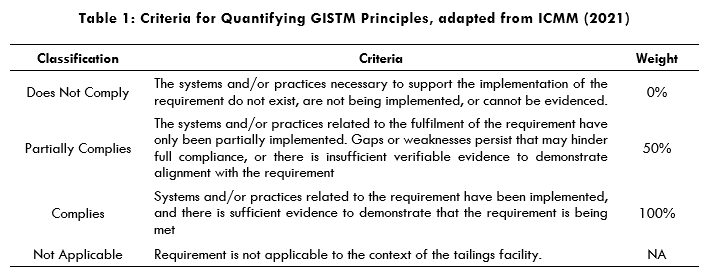
This classification allows for the assignment of different weights to the evaluated requirements, enabling the quantification of the level of conformance with the standard, calculated as the simple average of the weights assigned to the applicable requirements.
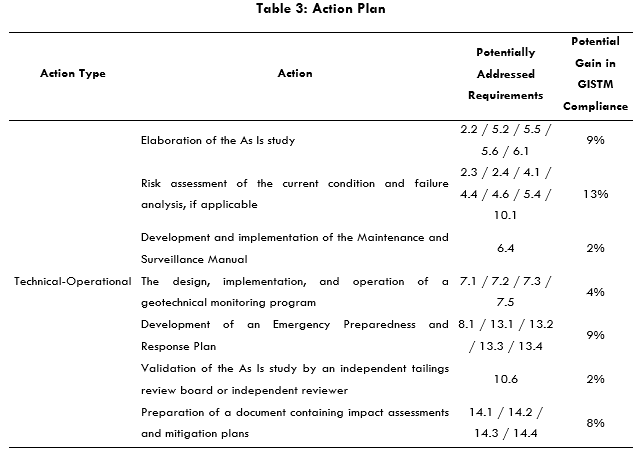
Based on this diagnostic, the audit identified the outstanding documents and studies required to achieve full compliance with the GISTM, indicating, for each item, the corresponding requirements and the potential increase in adherence that could be achieved upon implementation. This approach supports the operator in prioritizing the actions and studies to be carried out.
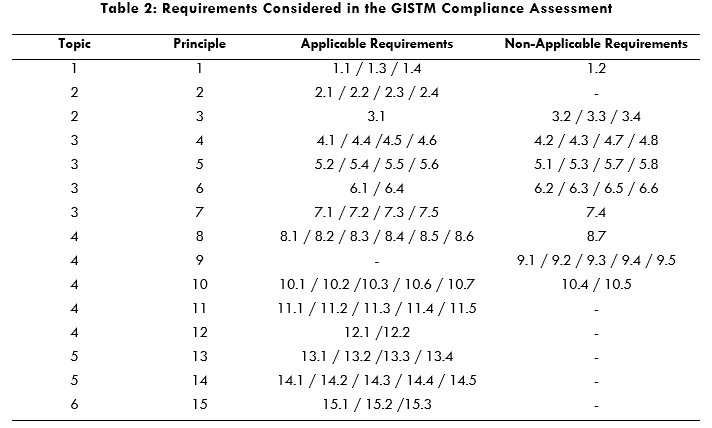
In the GISTM conformance assessment, 52 requirements were deemed applicable and included in the analysis, based on the specific context of the tailings facility at the time of the study. Table 2 presents the list of these requirements. This scoping is essential to enable a fair evaluation aligned with the project’s reality, prioritizing aspects that directly affect safety and tailings management in the current phase.
The following is a summary discussion of the key aspects related to the assessment of conformance with the GISTM for each of its 15 principles:
Principle 1, which emphasizes the integration of human rights protection in tailings management, was fully met, with 100% adherence. The evaluation considered elements such as managing human rights risks throughout the facility’s lifecycle and promoting free, prior, and informed consent for potentially affected Indigenous communities. Requirement 1.2 was deemed not applicable due to the absence of Indigenous communities in the project area.
In contrast, Principle 2, which addresses the need for the continuous development and updating of knowledge on the local socio-environmental context, showed only 38% adherence. This result highlights the need for more comprehensive risk assessments and the completion of breach studies, particularly after the As-Is study is finalized.
Principle 3, related to the integration of social, environmental, economic, and technical knowledge in lifecycle decision-making, achieved full adherence (100%). It is worth noting that only Requirement 3.1 was deemed applicable in this assessment, since Requirements 3.2 and 3.3 apply to new facilities, and Requirement 3.4 refers to facilities that have undergone changes.
On the other hand, Principle 4, which pertains to developing design plans and criteria that minimize risk throughout the facility’s lifecycle, had 25% adherence. The low score points to the need for failure mode analyses, especially after completing the As-Is study. It should be noted that requirements 4.2, 4.3, 4.7, and 4.8 were deemed not applicable, as they pertain to new structures, projects yet to be implemented, or the need for an Engineer of Record (EoR), which does not apply to the evaluated facility.
Regarding Principle 5, which focuses on designing robust and safe projects, the adherence was just 13%, indicating significant documentation gaps that can be addressed through the As-Is study and failure mode assessment. Requirement 5.1 was deemed not applicable, as it applies only to new or expanded structures; requirement 5.3 refers exclusively to the assessment of tailings facilities with reservoirs; and requirements 5.7 and 5.8 were disregarded, since the facility is classified as having low consequence, according to GISTM.
Principle 6, which guides safe planning and operation of the facility, showed zero adherence, underscoring the need for a maintenance and surveillance manual. Requirements 6.2, 6.3, 6.5, and 6.6 were deemed not applicable as they address issues related to the construction phase of a tailings facility.
Principle 7, which calls for the development of effective monitoring systems, achieved 50% adherence. Although some monitoring mechanisms exist, improvements are needed, including the creation of a monitoring plan based on failure modes and a maintenance and surveillance manual. Requirement 7.4 was deemed not applicable, as the facility does not require the involvement of an EoR.
Principle 8 requires policies and systems to ensure the safety and integrity of tailings facilities. Based on the available data, adherence to this principle was 58%. Suggested improvements include developing an Emergency Preparedness and Response Plan, impact assessments, mitigation plans, and a safety-based performance incentive program. It should be noted that requirement 8.7 was disregarded, as the failure consequence classification of the structure does not fall within the conditions established by this requirement.
Principle 9, which recommends appointing an Engineer of Record, was deemed not applicable as the facility is closed, and such designation is not required.
Principle 10, dealing with the establishment of levels of technical review and quality control, scored low (20%). This reflects the need for risk evaluations, independent revision of the closure plan, and implementation of a robust tailings governance structure with clear roles, responsibilities, and documented processes, along with periodic audits to ensure effectiveness. Requirements 10.4 and 10.5 were deemed not applicable, as the facility is decommissioned and classified as low consequence in the event of failure.
Principle 11, which relates to fostering a learning culture that promotes early risk identification and effective communication, achieved 60% adherence. Improvements are needed in interdepartmental collaboration, data sharing, and implementation of public safety measures and structural integrity practices.
Principle 12, concerning whistleblower protection and reporting channels, showed full adherence (100%).
Principle 13, addressing emergency preparedness, had zero adherence. This scenario emphasizes the need to develop an Emergency Preparedness and Response Plan and related impact and mitigation assessments.
Principle 14, which concerns long-term recovery planning in the event of catastrophic failure, recorded 20% adherence, indicating the need to develop impact assessments and mitigation strategies specific to the tailings facility.
Finally, Principle 15, related to transparency and public disclosure of facility management information, reached 67% adherence. It is important for the company to regularly publish and update information on its commitment to safe tailings management.
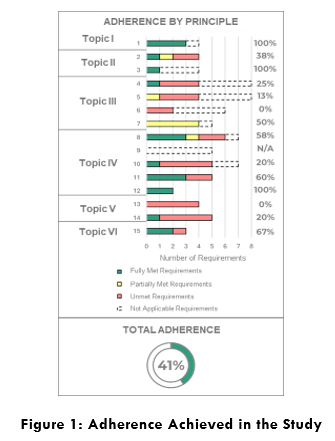
Figure 1 summarizes the average adherence obtained for each of the 15 GISTM principles, as well as the total adherence (41%) based on the collective evaluation of applicable requirements. The legend indicates: green for fully met requirements, yellow for partially met, red for unmet, and dashed lines for those not considered in the assessment.
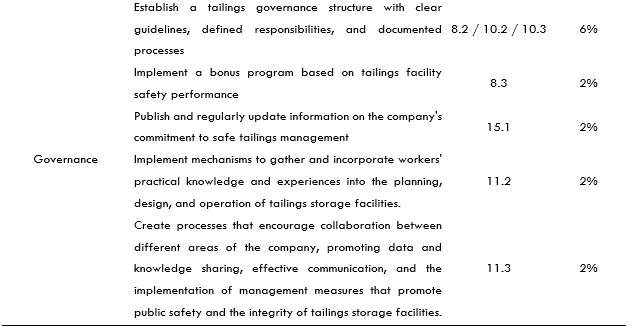
Following the calculation of adherence to the GISTM, an action plan (Table 3) was developed based on the identification of improvement opportunities to enhance compliance with the standard. The proposed actions were grouped into two categories: technical-operational and governance. The technical-operational actions relate to documentation and procedures specific to the tailings facility, while the governance actions are focused on good practices aimed at implementing an effective tailings management system, regardless of the facility. Additionally, each action was assigned a potential adherence gain to the GISTM, with the objective of guiding the prioritization of initiatives to be undertaken by the operator.
The application of the GISTM compliance assessment methodology to the analysed tailings facility enabled the clear identification of key areas for improvement in meeting international safety and governance requirements.
Principles 1, 3, and 12 demonstrated full compliance, addressing, respectively, the protection of human rights in tailings management, the integration of multidisciplinary knowledge in decision-making throughout the facility’s lifecycle, and the existence of whistleblower channels with protection mechanisms. It is noted that the documents and procedures associated with these principles are often linked to corporate governance requirements applicable to the overall establishment and operation of the enterprise, which facilitates compliance by the operator, as many of these requirements precede the development of the tailings facility project itself.
Principles 5, 10, 13, and 14 showed the lowest levels of compliance. These principles relate, respectively, to the robustness of tailings disposal designs, the implementation of technical reviews and quality controls, emergency preparedness, and planning for recovery in the event of catastrophic failures. The low compliance may be attributed to the fact that these requirements demand a high level of technical maturity, often associated with consolidated, large-scale operational structures. Since the assessed facility was constructed during a pilot phase, it is plausible that key documents, such as detailed engineering designs, risk assessments, emergency response plans, and long-term mitigation strategies, were not developed or formalized, resulting in low compliance with these GISTM principles.
Therefore, the adopted methodology enabled a fair, objective audit that was consistent with the reality of the assessed facility. Given that there is currently no standardized methodology established by the GISTM governing bodies to quantify adherence levels, the assessment criteria were defined by the auditor, who considered the specific context of the case. This approach supported a balanced evaluation, avoiding disproportionately penalizing the facility.
Furthermore, the methodology allowed for the development of a structured action plan, in which each proposed measure is associated with a potential gain in GISTM compliance. This enables the operator not only to visualize the expected impact of each action on overall conformance but also to prioritize initiatives accordingly. As such, the operator has a tool to strategically allocate resources and efforts towards actions that yield the greatest returns in safety, governance, and alignment with GISTM principles.
Lastly, it is important to emphasize that full implementation of the GISTM should be understood as an ongoing process that requires investment, technical capacity building, and strengthened corporate governance. Nonetheless, it undoubtedly leads to significant benefits for operational safety. It is expected that this study will contribute to the dissemination of good practices in the mining sector, serving as a reference for self-assessment in companies seeking to align with the highest international standards of safety and sustainability.