


INTRODUCTION
Increasing environmental restrictions and heightened concerns regarding the safety of containment structures have driven the development of alternatives to conventional tailings disposal methods. Among these alternatives, this paper focuses on the combined disposal of waste rock and dewatered tailings in mine waste stacks, which may provide benefits in terms of footprint and storage optimization, operational efficiency, and risk management.
Internationally, different approaches to combined disposal have been proposed and applied in mining practice, often using different terminology and classification criteria (Hawley & Cunning, 2017). For the purposes of this study, two distinct combined disposal strategies are considered based on the Brazilian standard ABNT NBR 13028-1/2025 – Preparation, Presentation of Design Documents and Safety Assessment of Structures for Tailings Disposal, Sediment Containment and Water Storage (Part 1 – Terminology): Co-disposal refers to the practice in which tailings are mixed with waste rock prior to placement in the storage facility, although mixing may also occur during the disposal process itself. Shared disposal, in contrast, refers to the placement of tailings and waste rock within the same storage facility without prior mixing, through a controlled spatial arrangement. Figure 1 illustrates the two combined disposal strategies considered in this study. 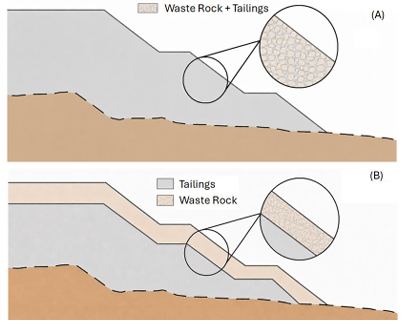
The planning and design of combined disposal facilities require an assessment of the volumes generated for each material and their relative proportions. However, these aspects must always be evaluated within the context of operational constraints, which may significantly constrain design decisions. This raises fundamental design questions: which disposal strategy provides the most predictable behavior, and how can waste rock and dewatered tailings be arranged to maximize shear strength, drainage efficiency, and erosion resistance under realistic operating conditions?
This paper examines the geotechnical and hydraulic implications for the design of mine waste stacks involving the combined disposal of waste rock and dewatered tailings, considering both co-disposal and shared disposal under operational conditions. It focuses on the limitations of directly applying results obtained from laboratory tests conducted under controlled conditions to engineering design and proposes practical recommendations for the design of this type of structure. The paper is organized into three parts: a discussion of the role of material proportion, followed by an analysis of the operational limitations of co-disposal and an evaluation of shared disposal as a design strategy.
METHODOLOGY
This study adopts a technical-conceptual and practice-oriented qualitative assessment of combined disposal strategies for waste rock and dewatered tailings in mine waste stacks, considering the geotechnical and hydraulic aspects associated with the behavior of these materials under operational conditions.
The assessment is based on a review of published literature addressing co-disposal and shared disposal, the interpretation of the concepts presented in these studies in light of their applicability to full-scale mining operations, and engineering experience obtained during the design, review, and technical assessment of mine waste stacks.
Based on these sources of information, the implications of each disposal strategy were comparatively evaluated with respect to geotechnical performance; hydraulic behaviour; constructability; operational constraints and implications for engineering design.
RESULTS AND DISCUSSION
Material Proportion as a Design Consideration
The volumes of waste rock and tailings generated throughout the life of the disposal structure, together with their relative proportions, represent an important design constraint for combined disposal stacks, regardless of the disposal strategy adopted. In addition to reflecting the relative availability of each material during the construction and operation of the disposal structure, this proportion directly influences the possible structural configurations of the structure and the potential to optimize the use of the geotechnical and hydraulic characteristics of each material.
Beyond the volumetric relationship itself, the way these materials are spatially arranged becomes equally important. Localized tailings zones may govern critical performance mechanisms, particularly in terms of stability and seepage, even when waste rock is volumetrically predominant.
Material proportion should therefore be evaluated strategically to make the best use of each material within the limits imposed by its availability, enabling improved mechanical performance, greater storage capacity, and enhanced hydraulic performance through reduced runoff, drainage requirements, sediment generation, and sump demand.
Consequently, the definition of material proportion extends beyond the expectation of improving the behavior of a mixture. Instead, it becomes associated with the ability to organize material placement in a strategic manner, resulting in a structure with reasonably predictable performance.
Limitations of Co-disposal Under Operational Conditions and Implications for Desig
Experimental studies investigating co-disposal commonly evaluate homogeneous waste rock tailings mixtures prepared with predefined proportions and uniform material distribution throughout the test mixture.
Silva & Silva (2024), for example, investigated homogeneous mixtures of phosphate mining waste rock and slurry tailings and the strong influence of incorporating granular waste rock into the mixture. The resulting mixtures exhibited internal friction angles of approximately 40°, compared with 31° for the tailings alone. However, these results are obtained under controlled conditions.
In full-scale disposal structures, material heterogeneity is inherent to construction variability, sequence and particle-size distribution, leading to localized hydraulic contrasts and distinct geotechnical responses (Hawley & Cunning, 2017).
The geotechnical behavior of waste rock–tailings mixtures depends directly on mixture configuration and fabric, indicating that deformation, settlement and seepage behaviour may vary considerably depending on the internal arrangement of materials (Burden & Wilson, 2023).
In this context, the use of average mixture properties in a co-disposal arrangement may not adequately represent the critical mechanisms governing overall structural performance, particularly when materials with contrasting hydraulic and mechanical characteristics remain distributed in a non-uniform manner (Hawley & Cunning, 2017).
Homogeneous mixing is difficult to reproduce under operational conditions; therefore, the improved properties measured in laboratory-prepared mixtures should not be assumed to characterize the full scale structure. A more conservative design approach is therefore to assume that structural performance will be governed by the material exhibiting the poorest performance for the mechanism being evaluated, rather than by laboratory-prepared mixture properties.
These observations should not be interpreted as an indication that co-disposal should be avoided. In some situations, operational constraints, such as limited available area or difficulties associated with maintaining temporary stockpiles, may render material segregation impractical, making co-disposal an operational solution rather than a deliberate design choice. The influence of such constraints on the selection of disposal strategies was also observed by Santos et al. (2025), who evaluated alternative co-disposal methods for a copper mining operation at the Sossego Complex (Pará, Brazil), involving hydraulically deposited copper tailings excavated from the tailings beach and coarse waste rock from open-pit mining. Their multicriteria assessment showed that operational feasibility, the waste rock-to-tailings production ratio, construction control requirements, and mass balance flexibility played a decisive role in selecting the preferred disposal strategy.
The waste rock-to-tailings ratio significantly influences operational feasibility from the standpoint of mixture workability and may require specific evaluations depending on the volumetric relationship between materials (Silva, 2014).
Shared Disposal as a Strategic Design Approach
As an alternative to co-disposal, shared disposal allows control over the internal arrangement of materials and, consequently, over the engineering functions assigned to each material. Under this approach, waste rock and tailings are strategically positioned to enhance overall structural safety, promote controlled seepage and pore pressure dissipation, and minimize sediment generation.
Silva (2014) and Carvalho (2017) reported that controlled spatial arrangement of waste rock and tailings may improve drainage conditions and increase overall structural stability. According to Carvalho (2017), a typical shared disposal configuration for dewatered tailings consists of a continuous external shell of waste rock, particularly along the stack slopes, enclosing internal tailings zones. Shared disposal strategies may include the use of cells for tailings placement, injection of tailings into waste rock deposits to form discrete pockets, and gravity placement of tailings in thin layers alternating with thicker waste rock layers.
Santos et al. (2025) compared different combined disposal methods and concluded that a compartmentalized configuration, consisting of an external waste rock shell and an internal tailings core, provides greater operational flexibility and reduces the dependence on rigorous construction controls than configurations based on material mixing.
Considering the typical behavior of granular waste rock compared with fine-grained tailings, as described by Hawley & Cunning (2017), the use of waste rock on stack slopes tends to reduce susceptibility to particle erosion and sediment generation, thereby reducing sediment transport to containment systems and the associated maintenance requirements. The use of waste rock to reduce sediment generation may facilitate the adoption of shallower and more practical containment structures where high groundwater levels limit excavation depth. These hydraulic benefits may also contribute to reducing maintenance requirements during closure and post-closure.
From the perspective of surface and perimeter drainage design, the structure may exhibit greater infiltration when waste rock is predominantly coarse-grained or rockfill. Consequently, surface runoff may be reduced, resulting in lower design peak flows and longer times of concentration for the hydraulic design of perimeter drainage channels.
The use of basal drainage trenches may also be avoided through the placement of granular waste rock at the interface between the stack and the foundation and/or through the use of drainage blankets at intermediate elevations, preventing the development of excess pore pressures within the stack during operation.
From a stability standpoint, the presence of waste rock in external zones may promote the development of failure surfaces that are not controlled by the shear strength of the tailings contained within the structure. In this regard, the waste rock-to-tailings ratio remains an important consideration, as does the timing of material availability.
In scenarios where waste rock volumes are relatively small compared to tailings production, it may not be possible to place tailings within discontinuous internal zones. Under such conditions, even if waste rock is used along the stack slopes, the thickness of the waste rock shell may be insufficient to prevent failure surfaces from being controlled by the shear strength of the tailings. In such situations, waste rock may not contribute to the adoption of geometries that increase storage capacity, although it may still provide hydraulic benefits.
Where sufficient waste rock is available, tailings may be placed in discrete and discontinuous pockets enclosed by a continuous waste rock shell. Under these conditions, potential failure surfaces tend to develop predominantly within the waste rock or intersect only limited volumes of tailings, reducing the influence of tailings shear strength on overall stability. The discontinuous arrangement of tailings also avoids the formation of zones that may act as potential failure surfaces or seepage barriers, while allowing the geotechnical and hydraulic functions of each material to be more effectively utilized.
CONCLUSION
The evaluation of combined disposal strategies indicates that structural performance depends not only on the properties of the materials involved, but also on the engineering functions assigned to waste rock and tailings through their spatial arrangement within the structure.
The limitations of co-disposal are associated with the difficulty of reproducing, under field conditions, the homogeneous arrangements frequently assumed in laboratory studies, reducing the predictability of structural performance. Under co-disposal conditions characterized by high operational variability, localized tailings zones may govern the overall structural response even where waste rock is volumetrically predominant.
In this context, shared disposal represents a strategic alternative, allowing materials to be allocated according to their hydraulic conductivity, shear strength and erosion resistance. The use of waste rock in free-draining and structurally significant zones, combined with the controlled confinement of tailings, may enhance stability, reduce sediment generation and improve hydraulic performance.