


INTRODUCTION
Few industrial failures carry the systemic consequences of a tailings storage facility collapse. The disasters at Fundão (Mariana, 2015) and Córrego do Feijão (Brumadinho, 2019) in Brazil claimed hundreds of lives, contaminated river systems spanning thousands of kilometers, displaced communities, and generated liabilities that continue to shape corporate strategy and public policy years later (ICMM, PRI and UNEP, 2020). Beyond their immediate humanitarian toll, these events exposed a structural vulnerability in the mining industry’s approach to risk: the predominant focus on preventing failure had left operators poorly prepared for the question of what happens after failure occurs.
The Global Industry Standard on Tailings Management (GISTM), published in 2020 through the collaboration of UNEP, the Principles for Responsible Investment (PRI), and the International Council on Mining and Metals (ICMM), is the most comprehensive international response to this vulnerability.
The GISTM establishes principles spanning the entire lifecycle of tailings facilities, from design through closure. Principle 14 is singular in its scope: it requires operators to develop strategies not only for immediate emergency response, but also for the long-term operational continuity and social, environmental, and economic restoration of affected areas. This requirement effectively demands that operators remain organizationally viable and operationally capable over the years and decades following a catastrophic event a timeline that extends far beyond the reach of conventional emergency action plans.
The supply chain management (SCM) literature offers a rich theoretical vocabulary for understanding why operational continuity matters beyond the boundaries of a single facility. Wieland and Durach (2021) propose that supply chain resilience should be understood not merely as the ability to ‘bounce back’ to a prior state what they term engineering resilience but as the capacity to persist, adapt, or transform in the face of change. Viewed through this lens, a mining operation is not simply a facility; it is a node embedded in a complex, multi-tier supply network whose disruption propagates upstream and downstream in ways that are difficult to anticipate and costly to reverse (Zhao, Zuo, & Blackhurst, 2019). The failure of a tailings facility does not only threaten the affected site it threatens the entire value chain that depends on it.
This paper argues that Business Continuity Planning (BCP), structured within the ISO 22301:2020 framework, provides a systematic mechanism for fulfilling GISTM Principle 14 by ensuring that the operator retains the organizational, operational, and financial capacity to honor its recovery and reparation commitments over the long term. The argument is developed through a case study in which HIDROBR Soluções Integradas developed a BCP for a major integrated phosphate fertilizer producer in Brazil. The case demonstrates that the supply chain perspective specifically, the structured mapping of dependencies, criticalities, and cascading failure pathways is indispensable for operationalizing Principle 14 in the context of multi-site mining and processing operations.
The paper is organized as follows. Section 2 presents the theoretical framework, integrating supply chain resilience theory with the regulatory and normative context of GISTM Principle 14. Section 3 describes the BCP methodology. Section 4 presents the value chain analysis and essentiality survey results. Section 5 discusses the implications for Principle 14 compliance through five interconnected resilience pathways. Section 6 concludes with practical recommendations.
THEORETICAL FRAMEWORK
Mining as a Complex Adaptive Supply Network
The conventional representation of a mining operation as a collection of physical assets mines, processing plants, tailings facilities, transportation infrastructure understates its systemic nature. As Choi, Dooley, and Rungtusanatham (2001) first argued, supply chains are more accurately understood as complex adaptive systems (CAS): interconnected networks of autonomous agents that respond to their environments, exhibit emergent behavior, and reorganize following disruption. This framing has profound implications for tailings management. When a tailings facility fails, it does not disrupt a single facility in isolation; it activates cascading failure dynamics that propagate through the supply network according to the network’s structural properties.
Zhao et al. (2019) demonstrated through empirically grounded agent-based modeling of a 2,971-firm supply network that disruptions propagate through cascading node failures, and that proactive adaptive strategies those deployed in anticipation of disruption rather than in reactive response to it are significantly more effective in preserving network integrity. Their analysis showed that reactive strategies alone could leave networks exposed to systemic collapse under high-degree node removal, with proactive strategies reducing disruption probabilities by more than half in analogous network configurations. This insight is directly applicable to integrated mining and processing operations where a single downstream hub receives and transforms raw materials from multiple upstream extraction units: the structural centrality of such a node makes it the highest-priority target for continuity planning, regardless of whether it is the physical location of the tailings facility in question.
Wieland (2021), drawing on panarchy theory, extends this understanding by arguing that supply chains behave as social–ecological systems embedded in nested adaptive cycles operating at the supply chain, political-economic, and planetary levels. This framing is particularly apt for mining, where the physical destruction wrought by a tailings failure interacts with political-economic pressures regulatory responses, market reactions, community mobilization and environmental dynamics such as watershed contamination and land degradation, in ways that cannot be captured by conventional risk assessment. The panarchical view implies that resilience planning must account for cross-level linkages: the ‘revolt’ dynamic by which failure at the supply chain level cascades upward to trigger political-economic reorganization, and the ‘remember’ dynamic by which planetary-level constraints shape the available recovery pathways.
Engineering Resilience, Social-Ecological Resilience, and Antifragility
The SCM literature distinguishes between two fundamental interpretations of resilience. Engineering resilience the dominant paradigm in supply chain risk management focuses on the system’s ability to return to a prior equilibrium state following a disruption, measured through time-to-recovery (TTR) and time-to-survive (TTS) metrics (Wieland & Durach, 2021). This interpretation implicitly assumes that the supply chain is a closed, engineerable system with a single desirable steady state. Applied to tailings management, this paradigm suggests that the goal following a catastrophic failure is to resume production as quickly as possible a framing that is fundamentally insufficient for the scope of obligations established by Principle 14.
Social-ecological resilience, by contrast, defines resilience as the capacity of a system to persist, adapt, or transform in the face of change (Wieland & Durach, 2021). This interpretation acknowledges that catastrophic events may permanently alter the context in which the system operates, making a return to the prior state neither possible nor desirable. For mining operators, this distinction is critical: Principle 14 does not ask operators to ‘bounce back’ it asks them to lead a multi-year recovery process that transforms affected communities and ecosystems. This is, by definition, a social-ecological resilience challenge, not an engineering resilience problem.
Nikookar, Stevenson, and Varsei (2024) extend the theoretical frontier further by introducing the concept of supply chain antifragility the capacity of a supply chain to derive gains from disruption, not merely to survive it. Drawing on post-traumatic growth theory as a metaphor, they identify five capabilities that enable antifragility: supply chain mindfulness (continuous scrutiny of disruption dynamics), transformative learning (integrating lessons from disruptions into strategic adaptation), plasticity (swiftly disengaging from invalidated goals), bricolage (creative resource recombination), and collaboration (accessing partner resources during disruption). These capabilities are organized hierarchically, with collaboration as the enabling foundation. The BCP methodology cultivates several of these capabilities in structured sequence: the value chain mapping exercise builds supply chain mindfulness by systematically exposing network-level vulnerabilities; the essentiality survey develops the knowledge base required for transformative learning; and the identification of alternative input sourcing strategies begins to operationalize plasticity and bricolage at the network level.
Azadegan and Dooley (2021) contribute a typological perspective directly relevant to the governance of GISTM Principle 14 compliance. Their typology distinguishes between micro-level resilience (buyer-supplier dyad coordination for short-term risk management), meso-level resilience (cross-sector collaborations among multiple supply networks, self-organized and adaptive), and macro-level resilience (government-led or institutional coordination for long-term risk regulation). They demonstrate that anticipatory resilience of which Business Continuity Management (BCM) is a prime example is a central form of micro-level resilience, enabling firms to prioritize critical materials, suppliers, and processes through Business Impact Analysis. Crucially, they argue that no single resilience type is sufficient for large-scale disruptions: macro-level coordination (regulatory compliance with the GISTM), micro-level planning (BCP at the operational level), and meso-level coalitions (inter-company recovery coordination) must operate in concert. This typological framing clarifies that BCP for GISTM Principle 14 operates primarily at the micro level but interfaces with macro-level regulatory requirements and, in the long-term recovery phase, may need to activate meso-level collaborative structures.
Post-Disaster Planning and Business Continuity Management
The intersection of disaster management and continuity planning has received attention in the environmental assessment literature. Gore and Fischer (2014), analyzing post-disaster Environmental Impact Assessment (EIA) practice in Aceh Province, Indonesia, following the 2004 tsunami, demonstrate empirically that the baseline condition of institutional and operational systems before a disaster is a primary determinant of the quality and speed of recovery. Their study finds that pre-disaster preparation including formal business continuity management for key organizations could substantially reduce reliance on reactive, externally-supported capacity building in the post-disaster period. They explicitly argue that for organizations involved in environmental management systems, this preparedness ‘could be addressed through the process of business continuity management’ (Gore & Fischer, 2014, p. 74). This finding resonates directly with the GISTM Principle 14 context: the most critical limitation on post-disaster recovery is not the theoretical availability of recovery plans, but the institutional capacity of the operator to execute them over time. BCP is the mechanism by which this capacity is structured, tested, and preserved.
The GISTM Principle 14 Compliance Challenge
Principle 14 of the GISTM establishes requirements that, when read in their entirety, describe a multi-decade commitment: immediate safety response, operational continuity, coordinated stakeholder engagement, post-failure impact assessment, and sustained monitoring and public reporting. The standard recognizes that recovery from a catastrophic tailings failure is not a single event but a sustained process, and that the operator’s organizational and financial capacity is a prerequisite for that process (ICMM, PRI and UNEP, 2020). Yet the dominant operational tool available to operators the Emergency Action Plan (EAP) is designed for short-term response, not for the kind of multi-year, multi-stakeholder recovery process that Principle 14 envisions. BCP fills this gap by providing a structured methodology for identifying, protecting, and continuously restoring the operational capabilities that the recovery process requires.
The ISO 22301:2020 standard for Business Continuity Management Systems (BCMS) provides a normative architecture aligned with the adaptive, stakeholder-inclusive vision of Principle 14. Its requirements for organizational context analysis (Clause 4.1), BCMS scope determination (Clause 4.3), and system implementation and continuous improvement (Clause 4.4) map directly onto the iterative, learning-oriented approach that effective disaster recovery demands. Azadegan and Dooley (2021) note that empirical evidence demonstrates ISO 22301 implementation improves not only crisis preparedness but also financial and reputational performance a finding that reinforces the business case for BCP as a Principle 14 compliance instrument rather than a mere regulatory obligation.
METHODOLOGY
The BCP was developed following the ISO 22301:2020 framework and structured in six sequential phases: (1) diagnostic assessment, (2) value chain mapping, (3) essentiality survey, (4) BCP flowchart development, (5) action and monitoring plan, and (6) BCP consolidation document. This paper reports on the first three phases, which collectively constitute the analytical foundation the supply chain intelligence upon which the entire continuity plan is built. The subsequent phases, currently under development, will translate this intelligence into actionable continuity strategies and governance mechanisms.
The diagnostic assessment applied ISO 22301 Clause 4.1 to characterize the operational, environmental, and regulatory context of the production network. It mapped the internal and external conditions capable of affecting the organization’s continuity objectives, and established the normative boundary encompassing the GISTM, ISO 22301:2020, Brazilian dam safety legislation (Laws 12,334/2010 and 14,066/2020), and the operator’s internal management system standards. This phase is analogous to what Gore and Fischer (2014) term ‘pre-disaster preparation’ the institutional groundwork that determines whether post-disaster recovery is feasible at all.
The value chain mapping applied a quantitative dependency scoring methodology to characterize the material and logistical interdependencies among the production units. Building on the complex adaptive systems perspective, the mapping treated each production unit as a node in a supply network, and systematically characterized the directional flow of key raw materials and intermediate products between them. Four criteria were scored for each node: dependency on externally sourced run-of-mine ore (ROM), dependency on externally sourced mineral concentrate, dependency on externally sourced sulfuric acid, and contribution of concentrate output to downstream units. An additional criterion captured the number of other units operationally impacted by a given node’s disruption. The arithmetic sum of these weighted criteria generated a dependency degree score, classified as Low (0–2), Medium (3–5), High (6–8), or Very High (≥9). The scoring methodology was validated through structured interviews with operational and procurement managers and through visual flowchart review using a collaborative digital platform, ensuring the transparency of inputs that Principle 14’s public accountability dimension requires.
The essentiality survey focused on the production unit identified as the critical network node by the value chain analysis. It systematically mapped the essential inputs, processes, and physical structures whose disruption would cascade into operational shutdown. Two primary vulnerability dimensions were evaluated: dependence on recirculated process water managed by tailings-related hydraulic infrastructure, and dependence on inputs procured from a single external supplier. The survey combined document review, structured interviews with unit-level operational managers, and process flowchart mapping.
RESULTS AND DISCUSSION
The Production Network as a Complex Adaptive Supply System
The case study covers an integrated phosphate fertilizer production network in Brazil comprising multiple complexes that perform distinct functions along the value chain from ore extraction and mineral beneficiation to chemical processing and finished fertilizer production. The network exhibits the structural characteristics of a complex adaptive supply system as described by Choi et al. (2001): nodes are operationally autonomous yet deeply interdependent; connections involve both unidirectional material flows and reciprocal disruption exposure; and the system’s resilience is a function of network topology as much as of individual unit capability.
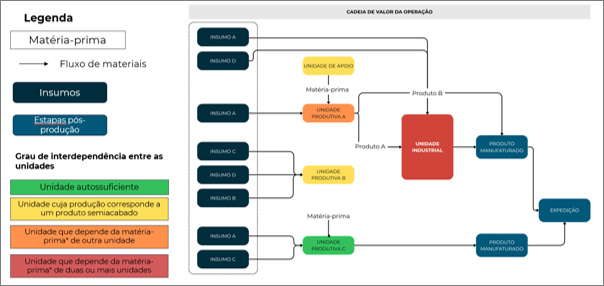
A defining feature of this particular network’s topology is its hub-and-spoke structure around a single downstream processing unit. Multiple upstream extraction and beneficiation complexes converge on one industrial hub that performs the chemical transformation of phosphate concentrate into finished fertilizers. This hub neither mines rock phosphate nor operates beneficiation infrastructure it is entirely dependent on concentrate supplied by the upstream network. From a supply network perspective, this configuration creates precisely the high-degree, high-centrality node that Zhao et al. (2019) identify as the most damaging point of potential failure: its disruption cascades upstream to constrain the operational rationale of every concentrate-supplying unit, and downstream to eliminate the market delivery capacity of the entire chain.
The dependency scoring methodology confirmed this structural intuition quantitatively. The downstream processing hub received the maximum possible score under the applied criteria, while the upstream extraction units received lower scores reflecting their greater operational self-sufficiency. Table 1 and figure 1 illustrates the scoring structure and the resulting classification by dependency tier. The anonymized presentation preserves the methodological substance while respecting operational confidentiality.
| Scoring criterion | Extraction units (typical) | Integrated units (typical) | Processing hub (critical node) | Max. weight |
| Ore (ROM) input dependency | Low (self-sufficient) | Variable | High (fully external) | 4 |
| Concentrate input dependency | N/A | Low–medium | High (fully external) | 2 |
| Sulfuric acid input dependency | Low | Low (self-produces) | Low | 1 |
| Concentrate output to other units | Low | Medium–high | N/A | 2 |
| Number of impacted units | Low | Medium | High (4+ units) | # |
| TOTAL DEPENDENCY DEGREE | Low (0–2) | Medium–High (3–6) | Very High (≥9–10) | 10 |
Source: Adapted from HIDROBR, 2025.
The Critical Node: Supply Chain Topology and Cascading Risk
The downstream processing hub presents a structural profile that is, from a network resilience standpoint, both understandable and concerning. Its position at the convergence of multiple upstream concentrate flows, combined with the absence of its own extraction and beneficiation capacity, creates what Wieland (2021), building on panarchy theory, identifies as the hallmarks of the conservation phase of the adaptive cycle: high connectedness and high potential, but diminished resilience. The very optimization of the network for production efficiency concentration of chemical processing at the largest unit, elimination of redundant capacity, reliance on dedicated transport corridors has simultaneously eroded the system’s ability to absorb disruption.
This topology has three compounding implications for continuity planning. First, any disruption at the processing hub cascades immediately to upstream extraction units, which rapidly exhaust their concentrate storage capacity and face production curtailment, even if their own facilities are physically undamaged. This is precisely the cascading failure dynamic modeled by Zhao et al. (2019), where the disruption of a central node can affect over a thousand downstream firms in a network in the mining context, the analogous cascade affects the livelihoods and operations of upstream workers, communities, and contractors. Second, the hub’s dependence on dedicated transport infrastructure for concentrate delivery introduces additional single-point failure exposure: disruption to a transport corridor represents an operational rupture functionally equivalent to the failure of a supplying unit. Third, the hub’s hosting of multiple water management ponds and tailings-adjacent structures essential components of the industrial water recirculation system creates a direct interface between the financial performance of the business and the physical integrity of tailings-associated infrastructure. A failure in this infrastructure is simultaneously an environmental emergency under Principle 14 and an operational emergency under the BCP.
This intersection where the tailings management obligation and the business continuity obligation converge at the same physical system is precisely the insight that validates BCP as the appropriate instrument for Principle 14 compliance. The BCP methodology, by mapping the operational dependencies of the hub before any failure occurs, performs the function that panarchy theory assigns to the reorganization phase: identifying the vulnerabilities created by the conservation phase and designing contingency pathways that restore adaptive capacity.
Essentiality Survey: Critical Processes and Vulnerability Categories
The essentiality survey structured the analysis of critical processes into three vulnerability categories, each with distinct implications for continuity strategy design. Table 2 presents the resulting criticality framework.
| Process category | Hydraulic infrastructure dependency | Single-source input dependency | Criticality classification |
| Raw material reception | None | None (multi-source) | Non-critical |
| Inorganic acid production | None | Partial (single reagent) | Moderate |
| Acidulation (chemical transformation) | High (direct) | None | Critical |
| Gypsum stacking and water recirculation | Central (hub) | None | Critical |
| Industrial effluent treatment | None | High (two reagents) | Critical |
Source: Adapted from HIDROBR, 2025.
The raw material reception process was assessed as non-critical, reflecting a multi-source supply structure that partially embeds Azadegan and Dooley’s (2021) anticipatory resilience through supply base diversification. This finding is methodologically significant: it demonstrates that the highest-risk node in a network is not necessarily vulnerable in all its processes, and that BCP should target interventions at processes with genuine single-point exposure rather than treating all operations of a critical unit as equally fragile.
The inorganic acid production unit dependent on an externally sourced elemental reagent from a single supplier was classified as moderate rather than critical, because the facility maintains on-site storage sufficient to buffer short-term supply interruptions. This arrangement illustrates what Nikookar et al. (2024) call supply chain bricolage making do with available resources through creative stockpiling but the single-source structure remains a strategic vulnerability that the subsequent BCP phases must address through supplier diversification or reserve augmentation protocols.
The three critical processes reveal distinct but interconnected failure mechanisms. The chemical transformation process (acidulation) is structurally dependent on the hydraulic infrastructure associated with tailings management: any failure in the gypsum stacking system or the water recirculation ponds would immediately interrupt the supply of recirculated process water that the transformation process requires, halting production. The gypsum stacking and water recirculation system is itself the direct interface between industrial operations and the tailings storage infrastructure precisely the point where the operational risk and the Principle 14 obligation converge. A physical failure at this interface is simultaneously a tailings management emergency requiring the response protocols of Principle 14, and a production emergency requiring the continuity protocols of the BCP.
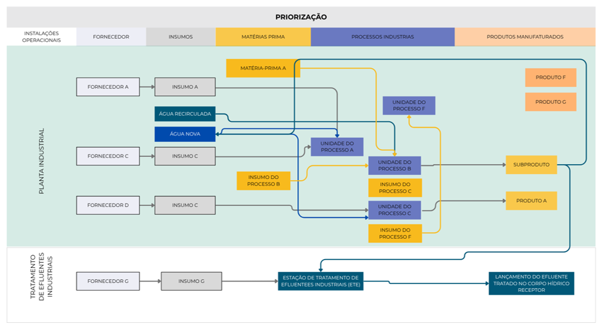
The industrial effluent treatment process presents a third and distinct failure pathway: its critical reagents are sourced exclusively from external single suppliers. A disruption in this input chain would prevent the facility from treating process effluent to the standards required for discharge, triggering an immediate environmental regulatory violation and mandatory operational shutdown. This pathway is the one most likely to cause catastrophic business continuity failure without any physical failure of the tailings infrastructure itself it represents what Zhao et al. (2019) characterize as the asymmetric vulnerability of supply chains, where the least visible dependency creates the greatest operational exposure. Its identification through the essentiality survey is a concrete illustration of why BCP, not just EAP, is required to fulfill Principle 14. Figure 2 illustrates the prioritization from essentiality flow materials.
BCP, GISTM Principle 14, and the Five Resilience Pathways
The theoretical framework and empirical findings converge on five pathways through which BCP, informed by supply chain resilience theory, fulfills the requirements of GISTM Principle 14.
The first pathway is operational viability as a precondition for reparation capacity. Principle 14 requires operators to sustain multi-year recovery processes involving community restoration, environmental remediation, and economic repair obligations that require financial resources and organizational capability only a viable operating entity can provide. The experience of the Mariana and Brumadinho disasters illustrates the point: Samarco’s temporary operational shutdown after Fundão significantly constrained its near-term capacity to fund remediation commitments, while Vale’s sustained financial capacity after Brumadinho enabled more rapid resource mobilization for recovery programs. The BCP, by mapping and protecting the critical capabilities that sustain operational viability, directly supports the operator’s ability to honor these long-term commitments. This connection mirrors the argument by Gore and Fischer (2014) that formal BCM is the most effective mechanism for reducing post-disaster institutional vulnerability.
The second pathway is supply chain mindfulness as the foundation for post-failure impact assessment. Principle 14 requires an updated post-failure impact assessment addressing social, environmental, and economic effects across affected areas. The value chain mapping and essentiality survey generate the baseline knowledge of interdependencies and cascade pathways from which such an assessment can be rapidly constructed after a failure event. In Nikookar et al.’s (2024) antifragility framework, supply chain mindfulness the continuous scrutiny of disruption dynamics to make complete sense of them is the first and foundational capability. The BCP methodology embeds this capability structurally: by mapping the network before a failure occurs, it ensures that the information infrastructure needed for post-failure impact assessment is already in place, rather than having to be reconstructed under crisis conditions.
The third pathway is transformative learning through the BCMS cycle. ISO 22301:2020 mandates the continuous review, update, and improvement of the BCMS a requirement that corresponds directly to what Nikookar et al. (2024) call supply chain transformative learning. Principle 14 similarly requires that continuity strategies be kept current and that monitoring programs be maintained and publicly reported. The alignment between the two frameworks reflects a shared recognition that resilience is not a static condition but a dynamic capability that must be actively cultivated through iterative organizational learning. The BCMS cycle is the institutional mechanism by which this learning is structured and perpetuated.
The fourth pathway is stakeholder collaboration as a structural requirement. Principle 14 explicitly requires that continuity planning contemplate the coordinated involvement of public agencies and affected communities in reconstruction, recovery, and restoration. Azadegan and Dooley (2021) categorize this requirement as necessitating the transition between micro-level resilience the operator’s internal BCP and meso-level resilience multi-organization collaboration for recovery that spans supply networks and institutional boundaries. Their typology suggests that for the extended recovery phases of a catastrophic tailings failure, meso-level coalitions may be as important as the operator’s own organizational capacity. The BCMS framework’s requirement for stakeholder engagement (ISO 22301 Clause 4.2) provides the institutional structure for formalizing these relationships before a crisis occurs, rather than improvising them under conditions of acute stress.
The fifth pathway concerns the transition from engineering to social-ecological resilience. The dominant EAP-centered approach to tailings emergency management reflects what Wieland and Durach (2021) characterize as engineering resilience: the aspiration to restore the system to its pre-failure state as quickly as possible. Principle 14, by contrast, demands a social-ecological resilience response: one that acknowledges that a catastrophic tailings failure permanently alters the context in which affected communities live and work, and that recovery must be guided toward a new, more desirable trajectory rather than a simple restoration of the prior state. The BCP, developed through the supply chain resilience lens, is the practical instrument that enables this transition it transforms the operator’s post-disaster response from reactive to adaptive and, over the long arc of recovery, potentially transformative.
CONCLUSION
This paper has demonstrated that Business Continuity Planning, structured within the ISO 22301:2020 framework and informed by supply chain resilience theory, constitutes both a theoretically grounded and practically effective mechanism for fulfilling GISTM Principle 14. The case study of a major integrated phosphate fertilizer producer in Brazil a multi-site network with a structurally critical downstream processing hub provides empirical grounding for this argument, illustrating how the supply chain perspective exposes systemic vulnerabilities that conventional facility-level risk assessment cannot capture.
Three theoretical contributions emerge from this work. First, the reframing of mining operations as complex adaptive supply networks, drawing on Choi et al. (2001), Zhao et al. (2019), and Wieland (2021), reveals that tailings facility failure is not a site-specific event but a network-level disruption whose consequences propagate through cascading failure dynamics. The BCP methodology, precisely because it maps these dynamics before they occur, is the appropriate instrument for managing them. Second, the distinction between engineering resilience and social-ecological resilience as elaborated by Wieland and Durach (2021) reframes the purpose of Principle 14 compliance: the goal is not to restore the pre-failure state but to guide transformation toward a more desirable one and BCP is the operational bridge between these two resilience paradigms. Third, the antifragility framework of Nikookar et al. (2024) suggests that the BCP, by cultivating mindfulness, learning, plasticity, bricolage, and collaboration capabilities in structured sequence, can enable the operator not merely to survive a catastrophic event but to emerge from it with enhanced organizational resilience reframing BCP investment from a compliance cost to a strategic asset.
The essentiality survey results yield a methodologically important finding that generalizes beyond this particular case: the highest-risk process in an integrated mining and processing network is not necessarily the most physically prominent one. The identification of a single-source chemical input dependency in the industrial effluent treatment system as the most operationally decisive vulnerability more decisive than the ore supply or the acid production illustrates that supply chain mapping is irreplaceable in surfacing the least visible but most disruptive exposure pathways. This finding has direct implications for how the mining industry approaches Principle 14 compliance: it cannot be fulfilled through EAP alone, because EAP does not map supply chain vulnerabilities.
The following practical recommendations are offered for mining operators seeking to comply with GISTM Principle 14 through BCP:
The BCP development described in this paper is ongoing; subsequent phases will produce the continuity flowchart, action and monitoring plan, and consolidated BCP document. Future publications will report on these phases and on the integration of BCP outputs into the emergency action plan and GISTM compliance governance structure. The methodology developed in this case study is transferable to other integrated mining operations facing Principle 14 compliance requirements, particularly those with multi-site, vertically disintegrated production networks characterized by high nodal interdependency and limited redundancy.