


INTRODUCTION
The instability Of tailings and waste rock stacks is a relevant issue for geotechnical and environmental safety in mining due to the potential for downstream material mobilization. Relevant knowledge gaps remain particularly regarding the mechanisms controlling material mobility after instability initiation, which tends to be governed by residual friction and requires numerical approaches capable Of adequately representing Hlis mechanism (Kundu & Gupta, 2022).
The numerical simulation of failure processes in geotechnical structures depends on the adopted numerical formulation and on how the resistance mechanisms Of the mobilized material are represented within the model. Different numerical approaches may describe this process through equivalent frictional resistance, two-dimensional flow with equivalent hydraulic parameters, or progressive deformation of a granular continuum. In this context, models such as MADflow and RiverFlow2D represent mass propagation using equivalent resistance parameters, whereas Material Point Method-based approaches, such as Anura3D, directly simulate stress and deformation evolution within the material (Conte et al., 2019). Consequently, the same input parameter may assume different physical meanings depending on the adopted formulation, influencing model response and sensitivity.
This work presents a comparative evaluation Of three numerical approaches applied to a mixed taihngs—waste rock stack. RiverF10w2D, MADflow, and Anura3D were evaluated under equivalent residual-resistance scenarios, considering residual angles Of I I a, 120, and 130. The comparison focuses on the longitudinal geometry of the final deposit and the propagation extent predicted by each formulation, providing insight into how different numerical formulations respond to equivalent residual-resistance scenarios.
METHODOLOGY
The analysis consisted Of comparing three numerical formulations applied to the same hypothetical pile, composed of predominantly Sandy tailings and granular waSte rock, using RiverFlow2D, MADflow, and Anura3D under residual friction angle scenarios Of II a, 120, and 130. These values were selected as a sensitivity range capable of producing relevant variations in simulated material mobility while remaining consistent with the expected residual behavior of the material. For all models, the comparison focused on propagation extent and the longitudinal geometry of the final deposit.
Although expressed as angular quantities, the tested parameters do not represent the same physical phenomenon in each formulation. In the frictional formulations (RiverFlow2D and MADflow), the response of the final propagation area was evaluated in terms of longitudinal reach and lateral spreading. In Anura3D, based on the Material Point Method, the analysis was carried out in profile, considering the longitudinal extent and the elevation evolution of the mobilized mass. The formulations adopted in each model are presented below, highlighting the role Of these parameters in the numerical representation of material mobility.
RiverHow2D
RiverFlow2D (version 8.12) is a hydrodynamic model that uses the Finite Volume Method to solve the Shallow Water Equations and describe the hydraulic behavior of two-dimensional flow. For the simulation Of stack failure, a purely frictional flow was considered, in which friction between particles is considered without pore pressure effects, by means of the granular formulation without erosion Of the natural bed (fixed bed). The flow resistance stress is given by Equation (I).

where p is the mixture density (kg/m3), g is gravitational acceleration (m/s2), h is flow depth (m), and Ob is the basal stability angle of the material, which is equivalent to the angle at which the material ceases its movement on a free surface. lhe basal friction angle is typically only a fraction of the Coulomb angle (McDougall and Hungr, 2006, as cited in Naef, 2006).
MADF10w
MADflow v2026 employs a depth-integrated Lagrangian finite-element formulation, representing the mobilized mass as a deformable continuum subjected to the balance between gravita tional forces and basal resistance along the topography. Considering the predominantly granular behavior of the material, the frictional rheology available in the model was usa, intrinsically based on the Coulomb formulation for shallow flows, in which the basal resisting stress is given analogously to Equation (l). However, tan 9h is numerically represented by the dynamic friction coefficient (μ).
The formulation follows the Savage-Hutter shallow-flow hypothesis, assuming thickness small relative to propagation length_ In the frictional rheology of MADflow, the RRATIO parameter defines the mobilized residual resistance and numerically corresponds to the effective residual friction coefficient used in the flow. Therefore, the material resistance is represented by the PRATIO and RRATIO parameters, associated With peak and residual resistance, respectively.

Where o-v’ is effective vertical stress, RRATIO controls the residual resistance after the loss of internal structure, influencing the final extent Of propagation, whereas PRATIO defines the maximum resis tance before failure and the energy released at the onset of movement, mainly affecting the initial flow velocity.
These parameters reproduce the typical stress-strain behavior of granular materials, with mobilization up to a peak strength followed by a drop to a residual regime.
Anura3D
The version of Anura3D used in the present study is the 2024 release. Anura3D is a numerical code based on the Material Point Method (MPM), suitable for simulating problems involving large deformations and large displacements. In MPM, the material is represented by material points that carry mass and State variables, while a background mesh is used to solve the equationg Of motion. This formulation allows the integrated representation of failure, deformation, and mass propagation, making it particularly suitable for the analysis Of tailings flows (Azevedo et al., 2024; Souza et ala, 2024). Thus, the residual strength of the material, given by the residual friction angle (pres), is represented by Equation (4).

The propagation of the mass is simulated by solving the stress-strain problem throughout motion, so that its evolution depends on topography, gravity action. and the constitutive parameters that control material strength. In purely frictional formulations, this resistance is represented by the residual friction angle, which controls the resistance mobilized during movement and directly influences the final extent of propagation (Qu et 2021).
Comparison criteria among the models
The comparison among the models was based on the longitudinal geometry of the final deposit, evaluating propagation extent and elevation variation along the main flow axis. TO ensure consistency among the approaches, a representative centerline was defined along the preferential flow path and discretized at 5 m intervals. Elevation values extracted along this profile were used to compare the responses of the different numerical formulations.
Residual angles Of 110, 120, and 130 were evaluated in all models as a sensitivity range for material resistance. In MADflow, a PRATIO value was additionally assigned to each scenario to represent peak resistance and the energy required to initiate material movement.
RESULTS AND DISCUSSION
Figure 1 presents the longitudinal comparison of the simulated results along the main propagation axis, considering the three evaluated models and the angles of I | 0, 120, and 130. The curves represent the longitudinal profiles obtained from each simulation, allowing direct comparison of the deposit geometry predicted by the different numerical formulations under equivalent residual-resistance scenarios.
The longitudinal comparison highlights high convergence among the models in the intermediate section and in the final portion Of the deposit, while the greatest differences are concentrated in the initial region, where representation of the initial elevation loss depends more directly on the adopted model.
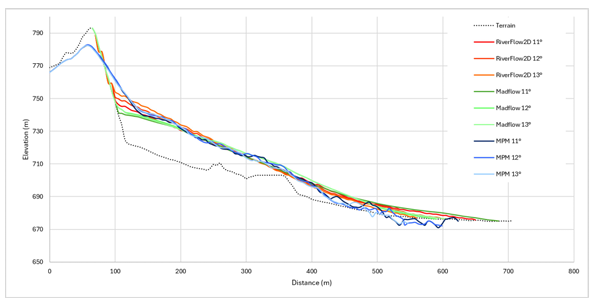
In MADflow, the 11º, 12º, and 13º scenarios were reproduced using PRATIO values of 0,194, 0300, and 0350, respectively. The increase in PRATIO with increasing residual resistance reflects the need for higher initial mobilization energy to initiate material movement under scenarios with greater residual strength.
In Anura3D (MPM), the residual friction angle acts as a constitutive strength parameter controlling the shear resistance mobilized during deformation. Consequently, lov,’er values favor greater propagation, whereas higher values restrict material movement. The influence Of this parameter should also be interpreted considering the spatial discretization adopted in the model, given its effect on the resolution Of the final deposit geometry.
Despite the fundamentally different formulations adopted by the three models, the longitudinal profiles exhibit a high degree Of agreement over most Of the propagation path. The general shape Of the deposit and the predicted runout extent remain comparable, indicating that the residual-resistance scenarios exert a Stronger influence on the overall response than the choice Of numerical formulation itself.
The largest differences are associated with the representation of material redistribution along the profile. Unlike the frictional formulations, which represent propagation through equivalent resistance parameters, the MPM approach explicitly resolves stress redistribution and deformation within the material. As a result, Anura3D tends to preserve local variations in deposit geometry, particularly in the proximal region where deformation mechanisms are more intense. Although the final runout distance remains comparable, the MPM formulation redistributes the mobilized mass differently along the profile, producing a slightly thinner deposit in the downstream section compand with RiverFlow2D and MADflow.
The close agreement between the RiverFlow2D and MADflow profiles suggests that, for the evaluated residual-resistance scenarios, both formulations produce a similar balance between gravitational driving forces and frictional dissipation. Consequently, differences in numerical implementation have a limited influence on the predicted longitudinal geometry when compared with the influence of the residual-resistance parameter itself.
Visual inspection Of the profiles further indicates that comparable longitudinal responses may be obtained from different combinations of numerical formulation and residual angle_ For example, the profile generated by MADflow With a residual angle Of 130 is similar to those obtained using RiverFlow2D at 12a and Anura3D at 130 over large portions of the deposit. This behavior suggests that direct comparison Of angular values among different nume rical approa ches should be made With caution, as similar mobility responses may correspond to different parameter values depending on the adopted formulation. Nevertheless, all three models exhibited a consistent response to increasing residual resistance, with changes of similar magnitude observed between the 11º, 12º, and 13º scenarios.
CONCLUSION
The three numerical approaches produced comparable longitudinal for the evaluated residual-angle scenarios, demonstrating that distinct numerical formulations can generate similar representations of material mobility. Although expressa by the same angular quantity, the tested parameters assume different physical meanings in each model, ranging from equivalent frictional resistance in RiverFlow2D and MADflow to a constitutive strength parameter in Anura3D.
For all approaches, increasing the residual angle from I I to 130 resulted in a consistent reduction in propagation extent and a corresponding increase in final elevations along the downstream portion Of the deposit. Despite the differences in formulation, the variations observed between the residual-angle scenarios were of similar magnitude, indicating a comparable sensitivity of the predicted mobility to changes in residual resistance.
The results also show that similar longitudinal profiles may be obtained from combinations Of numerical formulation and residual angle. Illis highlights the need for caution when directly comparing parameter values among models, since equivalent mobility r•esponses may correspond to different physical interpretations Of the angular parameter.
The lateral extent of the impacted area is an equally relevant consideration when assessing the failure Of a tailings and/or waste rock pile. [n this respect, the two-dimensional formulations Of RiverFlow2D and MADflow capture lateral spreading more directly, albeit in a simplified manner.
lt is also worth emphasizing that this class of modeling is intended to delineate the runout footprint restdting from the c 011a pse Of a tailings stora ge structure. Unlike dam-break analyses in which a breach-formation parameter and the flow arrival time can be explicitly defined — these models adopt an already-mobllized mass as their initial premise and therefore do not represent the triggering and incipient sliding stage, whose evolution may be either rapid Or slow.
Finally, the study demonstrates that RiverFlow2D, MADflow, and Anura3D provide consistent representations of material mobility over the range of residual resistance evaluated. The results emphasize that model response is strongly dependent on parameter selection and that the physical meaning assigned to a given residual angle depends on the adopted numerical formulation.