


The management of tailings generated from ore beneficiation processes represents one of the primary challenges in geotechnical engineering applied to mining, particularly due to the complexity of failure mechanisms associated with containment structures such as dams and tailings piles. Following the catastrophic failures of the Fundão (Mariana, 2015) and Córrego do Feijão (Brumadinho, 2019) tailings dams, there has been a significant shift in both regulatory and technical frameworks within the sector, which has also driven the in-creasing adoption of tailings stacking as a partial alternative to dam-based storage. This transition, in turn, demands the adaptation of conventional methodologies traditionally employed in dam stability analyses to suit this new class of structures, which are likewise susceptible to failure mechanisms. This scenario highlights the need to improve modeling tools used in risk assessment, with a particular emphasis on the ability to simulate large de-formations and post-failure propagation processes in particulate materials.
Among the currently available numerical methods, the Material Point Method (MPM) has emerged as a robust alternative for modeling geomechanical problems involving large displacements, severe deformations, and fluid-structure interactions. Unlike classical approaches such as the Finite Element Method (FEM), MPM allows for a more realistic representation of the dynamic behavior of unstable geomaterials and is particularly well-suited for simulating failure and mass movement processes in tailings, as demonstrated in recent studies (Lemus et al. 2025; Sordo et al. 2025; Mostafa 2022).
This study investigates the application of MPM, through the use of Anura3D software (Anura3D MPM Research Community 2020), to simulate the hypothetical failure of a typical homogeneous tailings piles approximately 100 meters in height, under varying residual strength and boundary conditions. The objective is to evaluate the influence of these parameters on the post-failure displacement extent (run-out), as well as to assess the effects of computational variables on the performance of dynamic simulations. By exploring these aspects, the study aims to contribute to the development of advanced analysis tools for the safety assessment of tailings structures and the enhancement of numerical modeling of complex geotechnical failures.
The present study adopts a two-dimensional approach to numerically model the failure of a homogeneous tailings piles using the Material Point Method (MPM) as implemented in the Anura3D software (version 2024).
The tailing pile was composed of a homogeneous material with geotechnical properties representative of predominantly fine mining tailings. In this study, the elastoplastic Mohr-Coulomb constitutive model is adopted to represent the mechanical behavior of all materials used in numerical simulations. This choice is based on the model’s widespread application in conventional geotechnical analyses, the ease of obtaining strength parameters from literature, and its compatibility with the Material Point Method (MPM). Although simplified, the model provides an adequate description of the frictional behavior of soils and tailings under failure conditions, making it particularly useful for studies focused on failure propagation.
The Mohr-Coulomb model assumes a linear failure envelope in the stress-strain space, defined by shear strength parameters, cohesion (c) and internal friction angle (φ), as well as elastic parameters such as Young’s modulus (E) and Poisson’s ratio (ν). In the context of a hypothetical failure scenario, residual strength parameters are employed, representing the minimum shear strength retained by the soil even after large deformations.
The tailings were characterized as a fine-grained material, with low cohesion and a friction angle typical of silty-clayey soils, and a deformability modulus representative of an uncompacted material. The foundation was modeled as a stiffer material, exhibiting higher shear strength.
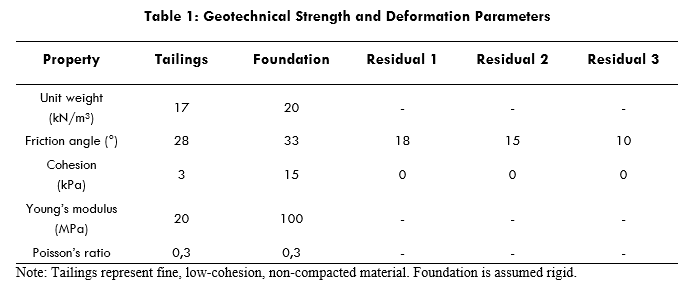
To evaluate the influence of residual friction on the post-failure propagation of the tailings mass, three scenarios were simulated with residual friction angles of 18°, 15°, and 10°, and zero cohesion in all cases. These values were selected based on previous studies available in the literature, which indicate typical residual strength ranges for saturated fine mining tailings—particularly under conditions of liquefaction or large deformation, as re-ported by Zabala & Alonso (2011), Llano-Serna & Alonso (2016), and Ulrich et al. (2015), where values between 10° and 20° were adopted to realistically represent the post-failure behavior of such materials. The input parameters used in the numerical model are presented in Table 1.
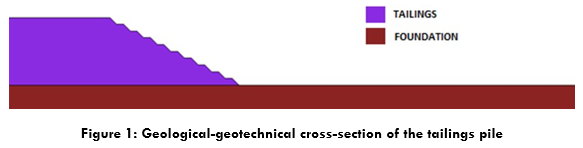
The stack geometry was idealized with an approximate height of 100 meters, lateral slopes of 2H:1V, and a flat base. The structure was positioned over a rigid foundation soil domain, which was assumed to be non-deformable in order to isolate the effects of tailings movement, as shown in Figure 1.
The base of the domain was defined as perfectly rigid, with full displacement constraints, while the lateral boundaries allowed only vertical movement. The model was initialized with the stack in a state of static equilibrium, free from any disturbances, in preparation for subsequent failure triggering.
The phreatic surface was positioned at depth, below the foundation of the structure, such that the tailings stack was in an unsaturated condition. As a result, the tailings were assumed to behave as dry material, with pore pressures neglected. This assumption simplifies the analysis and is consistent with operational scenarios where internal drainage is effective or where dry stacking practices are implemented.
Failure was induced by the instantaneous reduction of shear strength parameters (cohesion and friction angle) to the residual values defined in each scenario, simulating a critical in-stability condition. This procedure enabled the evaluation of tailings mobilization under different post-failure conditions.
To ensure numerical stability and accuracy of the dynamic simulation, the following computational parameters were defined:
The simulation duration was initially chosen arbitrarily to ensure that the material would propagate within a time frame shorter than the total simulation time. The influence of computational time (i.e., total simulation duration and time step size) was analyzed with respect to acceleration, velocity, and displacement of the material points, aiming to under-stand their effects on the evolution of run-out behavior.
The simulation enabled observation of the deformation evolution of the tailings stack from the onset of failure to the end of material movement. The collapse progression was characterized by intense deformation at the base of the stack, followed by mass mobilization along the flow direction. Localized shear zones gradually emerged, defining the failure pattern. The results for residual friction angles of 18°, 15°, and 10° are presented in Figures 2, 3, and 4, respectively.
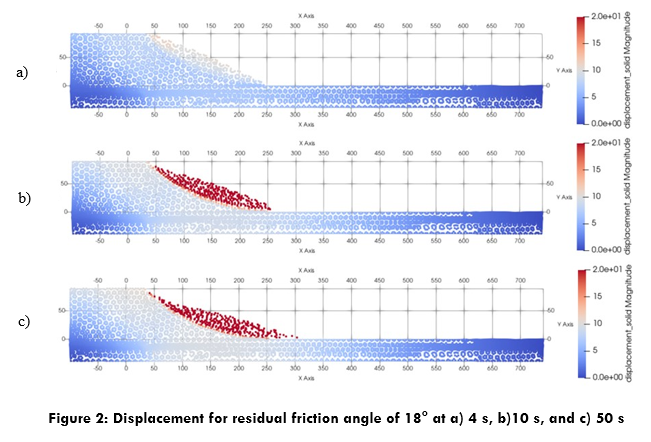
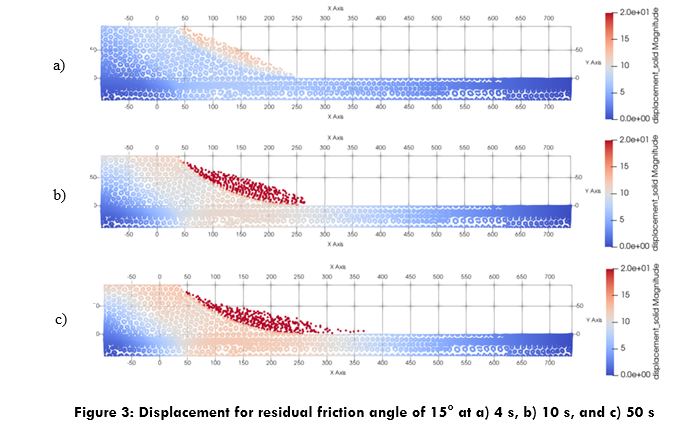
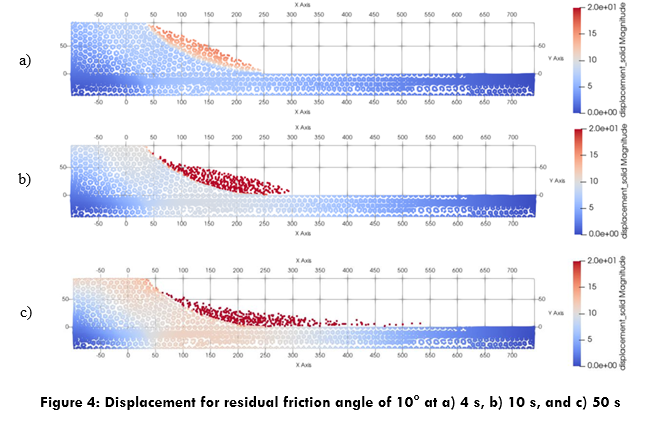
Three distinct scenarios were analyzed with different residual friction angles (10°, 15°, and 18°). It was observed that lower residual friction values resulted in longer run-out distances and prolonged dissipation times of the material movement. The scenario with the lowest residual strength exhibited a rapid initial acceleration. A comparison of the run-out propagation over time for the different residual friction angles is presented in Figure 5.
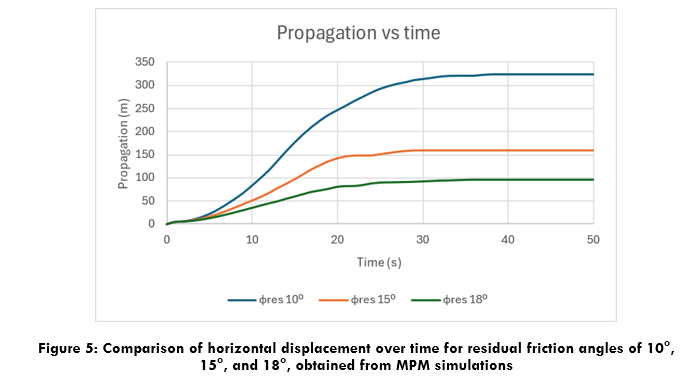
The results obtained in this study are consistent with findings from recent works that employed the Material Point Method (MPM) to simulate failures in geotechnical structures. Studies such as those by Lemus et al. (2025) and Mostafa (2022) highlight MPM as an effective tool for representing large deformations and post-failure propagation in particulate materials, behavior that was also observed in the present simulations involving fine tailings and varying residual strength values.
The correlation between the reduction of the residual friction angle and the increase in run-out distance has been reported by Zabala & Alonso (2011) and Llano-Serna & Alonso (2016), who noted that lower residual strength values lead to longer propagation distances and greater material mobility. This trend was confirmed in the three simulated scenarios of the present study, emphasizing that the proper definition of this parameter is essential for realistically capturing post-failure behavior in tailings piles.
The use of the Mohr-Coulomb model with residual parameters, although simplified, also follows a common approach in studies such as Ulrich et al. (2015), particularly in preliminary sensitivity analyses. The literature supports the notion that, even with such simplification, realistic responses can be obtained, provided that the model is adequately calibrated and the adopted values fall within experimentally observed ranges for similar materials.
This study presented an application of the Material Point Method (MPM) as a numerical tool to simulate the hypothetical failure of a tailings stack subjected to large deformations. The approach demonstrated a strong capability to represent the dynamic behavior of the structure under post-failure conditions, particularly with respect to the evolution of tailings mobilization and the sensitivity of the results to variations in residual strength.
The adopted methodology, based on two-dimensional modeling using Anura3D, proved effective for investigating failure propagation mechanisms and evaluating the impact of different boundary conditions and computational parameters on run-out and the global stability of the stack. Preliminary analysis indicates that the proper definition of residual strength parameters is critical for realistic prediction of post-failure behavior, a point widely acknowledged in specialized literature.
In addition, it was observed that the numerical parameters adopted in the simulations such as timestep control and artificial damping, exert a direct influence on result quality, requiring careful calibration to ensure the reliability of the model’s responses.
As for the next steps, the study aims to present the quantitative results of the simulations in progress, detailing the implications of the different scenarios analyzed. It is believed that this work will contribute to the advancement of numerical modeling techniques applied to tailings management, providing relevant insights for risk assessment in critical geotechnical structures.
It is important to highlight, however, that despite the usefulness of numerical modeling via MPM in representing failure and propagation phenomena, this type of analysis presents significant limitations when compared to real failure events. Among these are geometric idealizations, simplification of constitutive models, lack of hydro-mechanical coupling, and uncertainties in the definition of geotechnical parameters under critical conditions. Therefore, the results should be interpreted as indicative trends rather than deterministic predictions of the actual behavior of such structures.